







You know how it goes. You bring home a new electric scooter, charge it up, and suddenly you have no idea what you are actually allowed to do. Can you ride on the pavement? What about a helmet and paperwork? Here you will find everything you need, including where you could get caught out with a fine.
1. By law, your scooter is a bicycle
Under Czech law, an electric scooter counts as a bicycle. On it, you are not a driver and not a pedestrian. You are a cyclist.
It sounds like a technicality, but it is not. The moment you are a cyclist, the rules for bikes apply to you. Where you can ride, how alcohol works, when you need a helmet, it all follows from that.
2. Where you can ride
You belong on the road, on cycle paths and in cycle lanes. Skip motorways and roads meant only for cars, and otherwise you are at home almost everywhere.
The pavement is off limits. You can only push the scooter along it, not ride. The one exception is children under ten, who count as pedestrians, so they can use the pavement. Riding on the pavement can cost you a fine, usually up to around 2,000 CZK.
And one more thing. If there is a cycle path nearby, expect that you are supposed to use it.

3. From what age
You can ride on the road or a cycle path on your own from the age of ten. A younger child can ride there too, but only with someone over fifteen along.
An ordinary scooter needs no upper age limit and no licence. Paperwork only comes into play with more powerful machines. We will get to those in a moment.
4. Helmet
Up to the age of eighteen, a helmet is mandatory. Over eighteen it is not, but hand on heart, you only have one head.
We will not lecture you. Just a reminder that on a scooter you move at the speed of a car in a residential zone, and all that protects you is a t-shirt. A helmet is the cheapest insurance you will ever buy for it.

5. Forget the watts, speed is what counts
This is where the biggest confusion of the whole topic starts. People obsess over watts. Numbers like 250, 500 and 1000 fly around and everyone tells you something different. One repair shop put it well when they said that ten people will give you seven different answers.
Speed is what decides. As long as your scooter does not go faster than 25 km/h and is limited that way straight from the factory, you are still in bicycle mode. No licence, no plate, no technical inspection and no insurance.
The moment it goes faster, by law it turns into a moped. And that is a whole different world. Licence, registration, technical inspection and compulsory insurance.
Watch out for one thing. What matters is what the scooter can do, not what it happens to show on the display. If the limiter can be switched off in the app and the machine would do forty without it, that forty is what you are judged on, even when you are riding slowly.
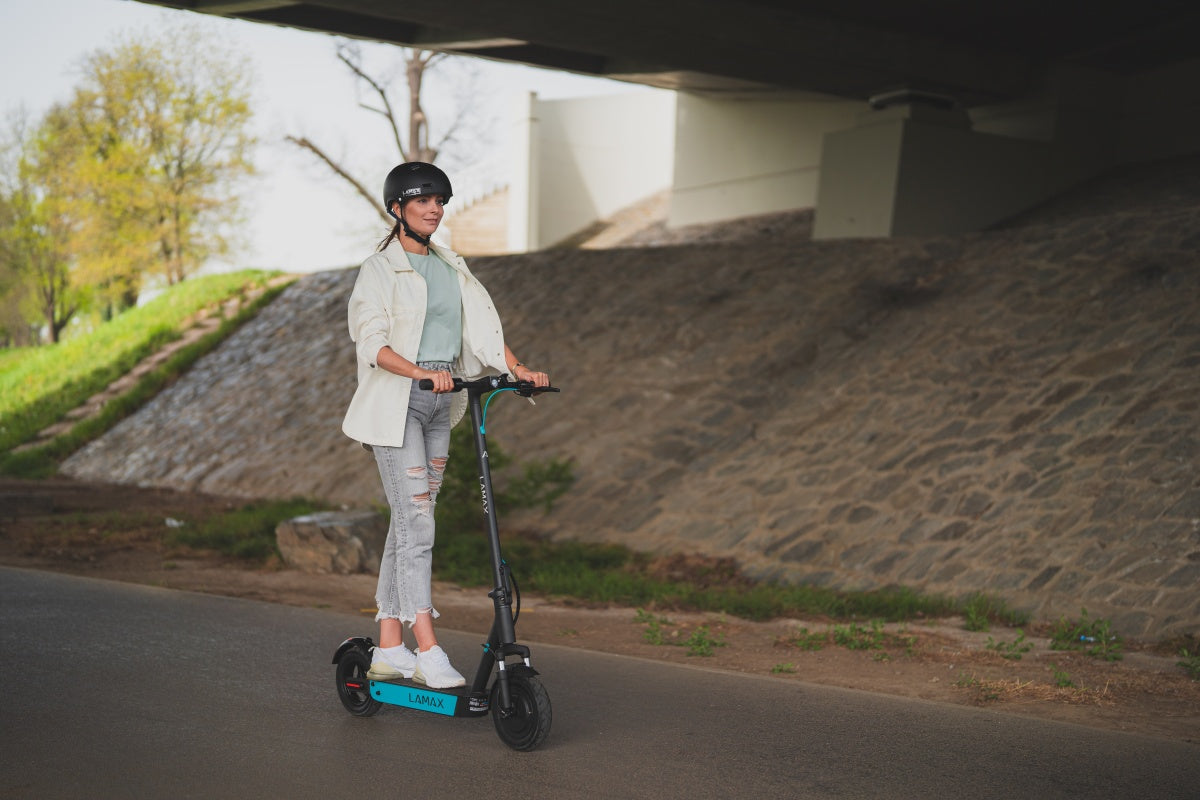
The easiest way to peace of mind is to get a scooter that is factory limited the way it should be. LAMAX scooters keep to that line, so you do not have to worry about the category and you just ride.

6. When you need insurance (and why it is not the same as watts)
Now pay attention, because almost everyone mixes this up. Whether you are a cyclist or a moped is one law. Whether you need liability insurance is a completely different one. And the thresholds are not the same.
Since April 2024, you need liability insurance when the scooter goes faster than 25 km/h. Or when it weighs over 25 kg and can do more than 14 km/h. An ordinary city scooter up to 25 km/h and under 25 kg therefore does not need a policy.
But if you are supposed to have one and you do not, it can hurt. The fine runs into tens of thousands of crowns. For more powerful models it is worth sorting out. It comes to a few hundred crowns a year, less than a single tank of petrol.
7. Alcohol and riding double
Two things everyone asks about. First, alcohol. For you as a cyclist the limit is zero. No beer, no exceptions, not even at the stalls along the cycle path. The fact that the police often let it slide at the stalls does not make it fine. If they catch you, you are heading into administrative proceedings and the fine is far from small.
And riding double? A scooter is built for one. Carrying someone on the footboard is dangerous, and they can deal with you for it too.
One more thing, because you will run into it in the headlines lately. If you have read about a ban on scooters on the pavement from September, breathe easy. That is Slovakia, not the Czech Republic. Here nothing major changes this year.
Quick check before you ride
- ✓ The scooter is factory limited to 25 km/h
- ✓ Front and rear brakes work
- ✓ White reflector or light at the front, red at the back
- ✓ You have lights on after dark
- ✓ A helmet on your head under eighteen
- ✓ Insurance sorted for a more powerful model
- ✓ You are a cyclist, not a pedestrian
FAQ
From what age can you ride an electric scooter on the road? You can ride on your own from the age of ten. A younger child can only use the road or a cycle path with someone over fifteen along. On the pavement, only a child under ten may ride, because the law treats them as a pedestrian.
Is a helmet on a scooter mandatory? Up to the age of eighteen, yes, a helmet is mandatory. Over eighteen it is no longer required, but we still recommend one, because on a scooter you have no bodywork around you.
Do I need liability insurance for a scooter? An ordinary city scooter up to 25 km/h and under 25 kg does not need liability insurance. It is required only for scooters that go faster than 25 km/h, or weigh over 25 kg and can do more than 14 km/h.


